Why We Built an AI That Does Variance Analysis (So Your Team Doesn’t Have To)
Why We Built an AI That Does Variance Analysis (So Your Team Doesn’t Have To)
It is Day 3 of the month-end close.
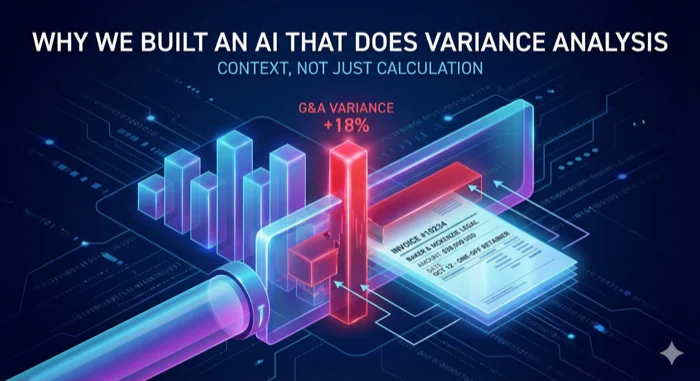
Your P&L shows a massive red flag: General & Administrative (G&A) expenses are up 18% against budget.
What happens next is a ritual every finance leader knows too well. You slack your Senior Analyst. They stop their current work, log into the ERP, download the General Ledger (GL) dump, open Excel, run a pivot table, isolate the variance, and start hunting for the specific invoices that caused the spike.
Then, they email the Department Head to confirm if the spend was planned. Then, they wait.
By the time you get the answer—“Oh, it was that one-off legal retainer fee”—two days have passed. You have the answer, but you’ve lost the time.
We built Lestar.ai because we believe finance teams are too talented to be spent on this kind of “forensic data entry.” We built an AI Analyst to automate the “Why,” so you can focus on the “So What.”
The “Check Engine Light” Problem
The fundamental issue with most traditional dashboards (PowerBI, Tableau) or Excel models is that they are excellent at showing you What happened, but terrible at telling you Why.
They act like a check engine light in a car. They glow red when something is wrong, but they don’t tell you if you need a new transmission or just an oil change. To find out, a human mechanic (your analyst) has to pop the hood and dig around.
In a modern enterprise, data is too voluminous and moves too fast for this manual excavation. When you rely on humans to manually bridge the gap between “High-level KPI” and “Transaction-level detail,” you create three problems:
- Latency: Answers take days, not minutes.
- Burnout: Your best talent gets bored doing data janitorial work.
- Missed Signals: Small but critical variances get ignored because no one has time to investigate them all.
Enter the AI Analyst: Context, Not Just Calculation
This is where the AI CFO capability within Lestar.ai’s CEO 360 module changes the game.
Unlike a static dashboard, Lestar acts as a centralized data repository. It holds your high-level financial reports and your granular transactional data (invoices, POs, GL entries) in one unified structure.
Because the AI has access to the full hierarchy of data, it doesn’t just flag the variance—it explains it.
The “Magic Moment”
Imagine that same G&A expense spike. Instead of emailing your analyst, you simply ask Lestar:
“Why is G&A variance so high this month?”
Within seconds, the AI analyzes the underlying transactions and responds:
“G&A is up 18% ($45k) vs Budget. The primary driver is a non-recurring payment of $38,000 to ‘Baker & McKenzie Legal’ processed on Oct 12th, which was not present in the forecast.”
The “investigation” phase is skipped entirely. You go from identifying the problem to understanding the root cause in 10 seconds.
Trust, But Verify (Eliminating Hallucinations)
We know what you’re thinking. “I can’t have an AI guessing about my financials.”
We agree. In finance, accuracy isn’t a feature; it’s a requirement.
This is why Lestar.ai is different from generic LLMs (like ChatGPT). Our AI is deterministic regarding data retrieval. It doesn’t hallucinate numbers; it queries your actual database.
Every insight the AI provides comes with Data Lineage. It shows its work. When it tells you legal fees drove the variance, it links you directly to the specific GL entries and invoice numbers. You verify the source instantly, ensuring that your audit trail is immutable and your confidence is high.
The ROI: Retention and Strategy
The ROI of the Automated Analyst isn’t just about saving a few hours of work—it’s about saving your team.
Modern finance professionals want to be strategic partners. They want to do scenario planning, cash flow forecasting, and business partnering. They do not want to spend 40 hours a month copy-pasting CSVs to figure out why the travel budget is off by $500.
By automating variance analysis, you aren’t replacing your analysts. You are promoting them. You are freeing them from the drudgery of “looking backward” so they can help you steer the company forward.
Stop Looking for Needles in Haystacks
The technology exists to close your books faster and answer board questions in real-time. It’s time to stop treating variance analysis as a manual hunt.
Let Lestar.ai find the needles in the haystack, so you can decide what to sew.
Ready to transform your financial reporting? Talk to the Lestar CEO360 team today.
More ESG Insights
Kimi K3's "Sputnik Moment": The License Terms Matter More Than the Benchmark Score
Moonshot AI's Kimi K3 triggered a stock selloff and a fresh "Sputnik moment" framing when it landed near frontier-model benchmark scores at a fraction of the cost. The more useful story for engineering teams is less visible: a Llama-style custom license with revenue and attribution thresholds, and a vendor disclosure that serving throughput was cut by more than half shortly after launch. Here's what to check before it goes into a build recommendation.
The Retrieval Architecture Debate: When Grep Beats a Vector Database, and When It Doesn't
Anthropic dropped vector search from Claude Code in favor of grep. Qdrant's enterprise customers are doubling down on vector search for their own agent workloads. Both are right — they're solving different retrieval problems. Here's a practical framework for figuring out which one fits yours.
Enterprise AI ROI in 2026: Why Efficiency Gains Aren't Becoming Revenue Growth
AI adoption is near-universal in 2026, but the financial payoff isn't following at the same pace. New survey data from McKinsey, Bain, and Deloitte shows why cost savings are landing reliably while revenue growth mostly isn't — and what separates the small group of companies getting both.
Ready to Centralise Your Enterprise Data?
Whether you need Lestar ESG for sustainability reporting, Lestar CEO360 for executive intelligence, or a fully customised enterprise data implementation — Mandrill Tech will tailor the solution to your organisation's needs.