Why We Built an AI CFO: Because Your Monthly Close Shouldn’t Take 15 Days
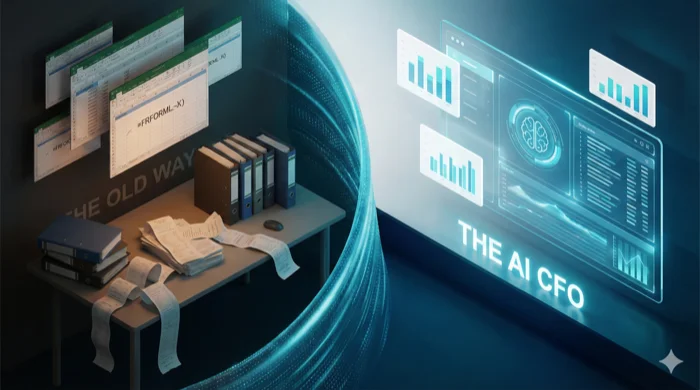
Why We Built an AI CFO: Because Your Monthly Close Shouldn’t Take 15 Days
If you are a Finance Director or CFO in 2026, you likely spend the first two weeks of every month living in “The Gap.”
The Gap is that high-stress period between the month ending and the final management report being ready. It is a time defined by downloading CSVs from ERPs, chasing department heads for expense receipts, and manually reconciling spreadsheets that break if a single formula is touched.
We realized that something was fundamentally broken. You hired your finance team to be strategic partners—to forecast, analyze, and guide the ship. But instead, you are paying them to be Data Janitors.
We built Lestar.ai because we believe your monthly close shouldn’t take 15 days. It should take 15 minutes.
Key Takeaways
- Days 11-15 (Report Formatting): Copy-pasting the now-clean data into PowerPoint decks for the board
- Result: No more “Data Scavenging.”
- Result: You catch errors on Day 1, not Day 15
- The Result: The CEO gets an answer 3 days later. By then, the strategic decision might have already been made on a gut feeling
- 0 Seconds: The query is received
The Anatomy of the 15-Day Delay
Why does the close take so long? It’s not because your team is slow; it’s because your data is fragmented. When we audited finance teams before building Lestar.ai, we found the “15-Day Delay” usually breaks down like this:
- Days 1-5 (Data Scavenging): Log into Xero/NetSuite, Salesforce, and Bank Portals. Download CSVs. Realize the Sales team hasn’t updated the pipeline. Send emails. Wait.
- Days 6-10 (The Excel Grind): Manually map the “Sales” column from the CRM to the “Revenue” column in the ERP. Spending hours looking for a $500 discrepancy in intercompany reconciliations.
- Days 11-15 (Report Formatting): Copy-pasting the now-clean data into PowerPoint decks for the board.
This process is reactive, error-prone, and demoralizing.
The Problem: Dashboards Are Not the Solution
For years, the industry told you the solution was “Business Intelligence” (BI). They told you to buy Tableau, PowerBI, or Looker.
But here is the hard truth: A dashboard cannot fix broken data.
A dashboard is a visualization tool, not a data engineering tool. If your financial data sits in Xero, your sales data in Salesforce, and your operational costs in a series of Google Sheets, a dashboard just shows you a pretty picture of a messy reality. You still have to do the manual “Data Scavenging” step before the dashboard works.
We didn’t want to build another dashboard. We wanted to build an intelligence layer that cleans the data for you. We wanted to build an AI CFO.
How the AI CFO Engine Works
An AI CFO isn’t a robot that replaces your job. It is a middleware layer that sits between your scattered apps and your decision-making.
When we developed the core technology behind Lestar.ai, we focused on automating the three hardest parts of the finance stack:
1. Unified Data Ingestion (The “Lakehouse”)
Instead of you downloading CSVs, Lestar.ai connects via API to your ERP, CRM, and Bank feeds. It pulls the data into a centralized repository (a “Single Source of Truth”) automatically, every single night.
- Result: No more “Data Scavenging.”
2. Autonomous Reconciliation & Anomaly Detection
The AI doesn’t just store data; it reads it. It scans for patterns. If an invoice amount doesn’t match the purchase order, or if a specific expense category spikes by 20% compared to the 3-month average, the system flags it immediately.
- Result: You catch errors on Day 1, not Day 15.
3. Text-to-Insight (The Interface)
We removed the need for complex SQL queries. You can ask questions in plain English, and the AI translates that into a database query to give you an answer.
The Difference: A Simulated Case Study
To understand the ROI of this shift, let’s look at a typical mid-sized Malaysian company. For confidential purposes, let’s call them TechCorp.
The Old Way (Without AI)
The CEO of TechCorp sends an email to the Finance Director at 9:00 AM: “What is our projected cash runway if revenue drops 10% next quarter?”
- The Workflow: The Finance Director has to open three different Excel models (Cash Flow, Revenue, Opex). They have to manually update the revenue assumptions, check if the hiring plan in HR’s spreadsheet has changed, and re-run the formulas.
- The Result: The CEO gets an answer 3 days later. By then, the strategic decision might have already been made on a gut feeling.
The New Way (With Lestar.ai)
Now, let’s look at how Lestar.ai handles the same scenario.
The CEO opens the Lestar.ai “CEO 360” command center. They type: “Scenario planning: If revenue drops 10% in Q3, how does that impact our cash runway?”
- 0 Seconds: The query is received.
- 1 Second: Lestar accesses the centralized repository where Finance, Sales, and HR data are already consolidated and up-to-date.
- 3 Seconds: The AI applies the 10% variable to the forecasting model.
- 5 Seconds: The CEO receives a chart showing the new runway, along with a generated summary: *“Runway decreases from 14 months to 11 months. Recommended action: Pause Q3 hiring plan.”*Total time: 5 seconds. No emails. No Excel. No waiting.
It’s Time to Stop “Reporting” and Start “Predicting”
We built Lestar.ai because the speed of business has outpaced the speed of traditional accounting.
With the looming 2026 compliance standards (like IFRS S2 and ESG reporting), the burden on finance teams is about to double. You cannot handle financial reporting and carbon reporting using manual spreadsheets. The risk of human error is too high, and the time cost is too great.
An AI CFO allows you to shift your focus from lagging indicators (what happened last month?) to leading indicators (what will happen next quarter?).
Ready to Upgrade Your Finance Stack?
You don’t need to hire a team of data engineers to build a warehouse like Snowflake. You need a business solution that works out of the box.
Stop accepting the 15-day close as “normal.”
Explore Lestar.ai capabilities or contact Mandrill today to schedule your CEO 360 Demo.
Ready to transform your financial reporting? Talk to the Lestar CEO360 team today.
More ESG Insights
Kimi K3's "Sputnik Moment": The License Terms Matter More Than the Benchmark Score
Moonshot AI's Kimi K3 triggered a stock selloff and a fresh "Sputnik moment" framing when it landed near frontier-model benchmark scores at a fraction of the cost. The more useful story for engineering teams is less visible: a Llama-style custom license with revenue and attribution thresholds, and a vendor disclosure that serving throughput was cut by more than half shortly after launch. Here's what to check before it goes into a build recommendation.
The Retrieval Architecture Debate: When Grep Beats a Vector Database, and When It Doesn't
Anthropic dropped vector search from Claude Code in favor of grep. Qdrant's enterprise customers are doubling down on vector search for their own agent workloads. Both are right — they're solving different retrieval problems. Here's a practical framework for figuring out which one fits yours.
Enterprise AI ROI in 2026: Why Efficiency Gains Aren't Becoming Revenue Growth
AI adoption is near-universal in 2026, but the financial payoff isn't following at the same pace. New survey data from McKinsey, Bain, and Deloitte shows why cost savings are landing reliably while revenue growth mostly isn't — and what separates the small group of companies getting both.
Ready to Centralise Your Enterprise Data?
Whether you need Lestar ESG for sustainability reporting, Lestar CEO360 for executive intelligence, or a fully customised enterprise data implementation — Mandrill Tech will tailor the solution to your organisation's needs.