The Modern Guide to Data Consolidation: Snowflake, Databricks, and Lestar.ai
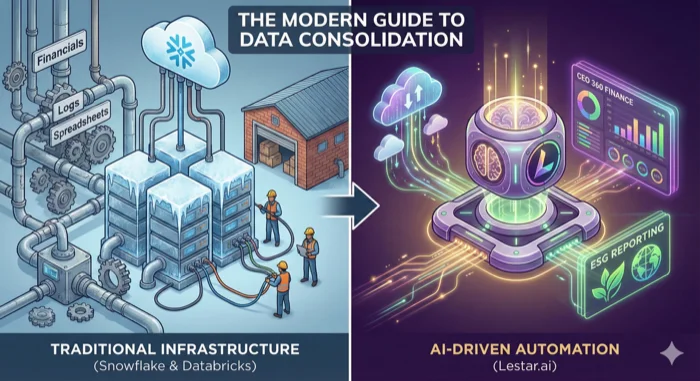
The Modern Guide to Data Consolidation: Snowflake, Databricks, and Lestar.ai
Data is only as valuable as your ability to access it. For most organizations, the reality is “Data Silos”—financials in one system, operational logs in another, and sustainability metrics hidden in spreadsheets.
Data Consolidation is the process of bringing all this disparate information into a single, unified repository. The benefits of getting this right are transformative:
- Single Source of Truth: No more arguing over whose spreadsheet is correct.
- Real-Time Agility: Decision-makers can see the state of the business instantly.
- Regulatory Compliance: Essential for accurately reporting ESG metrics and financial audits.
While the goal is always the same—unified data—the tools you use to get there work in very different ways. This guide compares the industry giants, Snowflake and Databricks, and introduces the specialized approach of Lestar.ai.
Key Takeaways
- Single Source of Truth: No more arguing over whose spreadsheet is correct
- Real-Time Agility: Decision-makers can see the state of the business instantly
- Regulatory Compliance: Essential for accurately reporting ESG metrics and financial audits
- Best For: Business Intelligence (BI), standard reporting, and organizations that rely heavily on SQL
- Consolidation Style:Structured. You create rigid tables and schemas, making it excellent for organized data like sales records and customer lists
1. The Industry Standards: Snowflake and Databricks
When companies think of “Data Consolidation,” they usually think of building a Data Warehouse or a Data Lake. The two leaders in this space are Snowflake and Databricks. Both are powerful platforms that provide the infrastructure to store and process massive amounts of data.
Snowflake: The Data Warehouse King
Snowflake revolutionized data storage by separating “compute” from “storage.” It is designed primarily for SQL analytics.
- Best For: Business Intelligence (BI), standard reporting, and organizations that rely heavily on SQL.
- Consolidation Style:Structured. You create rigid tables and schemas, making it excellent for organized data like sales records and customer lists.
Databricks: The AI and Lakehouse Leader
Databricks is built by the creators of Apache Spark. It pioneered the “Lakehouse” concept, which combines the structure of a warehouse with the flexibility of a data lake.
- Best For: Data Science, Machine Learning engineers, and processing heavy, unstructured data like video or sensor logs.
- Consolidation Style:Flexible. It allows you to dump raw data in and process it later using Python or R.
The Common Challenge
While powerful, both Snowflake and Databricks rely on the same fundamental process: Engineering.
To consolidate data in these platforms, you generally need a team of Data Engineers to write ETL Pipelines. You must manually define how Column A from one file maps to Column B in another.
2. The Lestar.ai Advantage: Automated Collection and AI Analysis
Lestar.ai takes a fundamentally different approach. It is not just a storage locker for data. It is a purpose-built AI-driven centralized data repository designed to streamline specific business outcomes like Finance (CEO 360) and ESG reporting.
The core difference is simple: Snowflake and Databricks give you tools to build a system. Lestar.ai gives you a system that is already built.
The Lestar Process: How It Works
The advantages of Lestar.ai become clear when you examine the consolidation workflow.
Step 1: Automated Data Collection (vs Manual Extraction)
The Snowflake & Databricks Way: Engineers write custom scripts to pull data from disparate sources. For ESG reporting, this often means emailing Excel files to suppliers and manually uploading responses.
The Lestar Way: Lestar provides automated data collection mechanisms.
- For ESG, it offers a centralized platform where unlimited users, including suppliers, input data directly into standardized digital formats.
- For Finance, it consolidates data into a single source of truth, eliminating spreadsheet reconciliation.
Step 2: AI-Driven Processing (vs Manual Maintenance)
- The Snowflake & Databricks Way: You own data quality. If the data is messy, engineers must write cleansing and validation rules.
- The Lestar Way: Lestar uses advanced AI algorithms and machine learning to streamline processing. Because it is optimized for Finance and ESG, the data is structured and audit-ready with minimal manual effort.
Step 3: Generative AI Output (vs SQL Queries)
The Snowflake & Databricks Way: Analysts must write SQL queries or build dashboards to extract insights.
The Lestar Way: Lestar integrates a generative AI chatbot. Once data is collected, users interact with it conversationally.
- Example: A CEO can ask, “What is our financial health overview?” or “Show me our ESG compliance status,” and receive instant insights.
3. Feature Comparison
| Feature | Snowflake & Databricks | Lestar.ai |
|---|---|---|
| Primary Focus | Infrastructure and Engineering | Business Outcomes (Finance & ESG) |
| Data Collection | Manual ETL pipelines | Standardized portals & digital inputs |
| User Interface | SQL editors, notebooks, command-line | Dashboards, Generative AI chat, prebuilt forms |
| Speed to Insight | Months (Build & Validate) | Weeks (Prebuilt Modules) |
| Best Use Case | Large-scale raw data storage | Rapid consolidation for decision-making |
4. Conclusion: Choosing the Right Tool
Data consolidation is no longer optional. It is the foundation of modern decision-making.
Snowflake and Databricks remain leaders in data infrastructure. They are ideal for organizations building large-scale platforms with dedicated engineering teams.
Lestar.ai offers a faster, smarter alternative for targeted business needs. By combining automated data collection with generative AI analysis, it enables finance and ESG consolidation without engineering overhead.
For many enterprises, the best strategy is not choosing one platform over another. It is using the right tool for the right job: Infrastructure platforms for raw data at scale, and Lestar.ai for automated, high-impact business reporting.
Ready to modernise your data capabilities? Talk to the Lestar team today.
More ESG Insights
Kimi K3's "Sputnik Moment": The License Terms Matter More Than the Benchmark Score
Moonshot AI's Kimi K3 triggered a stock selloff and a fresh "Sputnik moment" framing when it landed near frontier-model benchmark scores at a fraction of the cost. The more useful story for engineering teams is less visible: a Llama-style custom license with revenue and attribution thresholds, and a vendor disclosure that serving throughput was cut by more than half shortly after launch. Here's what to check before it goes into a build recommendation.
The Retrieval Architecture Debate: When Grep Beats a Vector Database, and When It Doesn't
Anthropic dropped vector search from Claude Code in favor of grep. Qdrant's enterprise customers are doubling down on vector search for their own agent workloads. Both are right — they're solving different retrieval problems. Here's a practical framework for figuring out which one fits yours.
Enterprise AI ROI in 2026: Why Efficiency Gains Aren't Becoming Revenue Growth
AI adoption is near-universal in 2026, but the financial payoff isn't following at the same pace. New survey data from McKinsey, Bain, and Deloitte shows why cost savings are landing reliably while revenue growth mostly isn't — and what separates the small group of companies getting both.
Ready to Centralise Your Enterprise Data?
Whether you need Lestar ESG for sustainability reporting, Lestar CEO360 for executive intelligence, or a fully customised enterprise data implementation — Mandrill Tech will tailor the solution to your organisation's needs.