Cash Flow Forecast: A Comprehensive Guide & Our Solutions
Cash Flow Forecast: A Comprehensive Guide & Our Solutions
Key Takeaways
- Cash flow forecasting projects a company’s future cash position to support better planning, investment decisions, and liquidity management.
- Accurate forecasts help businesses navigate uncertainty, optimise spending, and demonstrate financial control to investors or lenders.
- There are three main types of forecasts—short, medium, and long-term—each serving different planning horizons and objectives.
- Building a cash flow forecast involves gathering historical data, categorising income/expenses, and using rolling updates for real-time accuracy.
- Tools like Mandrill enhance forecasting through AI-based predictions, real-time BI dashboards, and ESG-integrated scenario planning.
Introduction
In today’s volatile market environment, cash flow forecasting has become a cornerstone of financial stability and strategic planning. Whether you’re managing a small business or a large enterprise, understanding future cash movement is essential to ensure you have the liquidity to operate, grow, and adapt to change.
A cash flow forecast helps you project how much money will flow into and out of your business over a given period, allowing you to plan for key expenses, prevent shortfalls, and make informed decisions about investments or financing.
This comprehensive guide covers what a cash flow forecast is, its benefits, different forecasting methods, and step-by-step instructions on how to build one.
You’ll also learn how advanced tools like Mandrill’s AI and BI dashboards can help you move beyond manual spreadsheets, offering smarter, real-time forecasting that aligns with both financial and ESG goals.
What Is a Cash Flow Forecast?
A cash flow forecast is a financial projection that estimates how much money will enter and leave your business over a specific future period. It gives you a forward-looking view of your liquidity, helping you understand whether your company will have enough cash on hand to meet its obligations.
This tool is essential for business planning, especially when it comes to making strategic decisions like hiring, purchasing equipment, repaying debt, or seeking funding. It also helps identify potential shortfalls in advance so that you can take corrective action before they become critical issues.
Cash flow forecasts can vary in scope depending on your goals:
- Short-term forecasts (weekly or monthly) help manage day-to-day liquidity.
- Long-term forecasts (quarterly or annual) provide insights for strategic growth, investments, or expansion.
By monitoring forecasted inflows and outflows, businesses can stay agile, resilient, and financially prepared — even in unpredictable market conditions.
Cash Flow Forecast Example
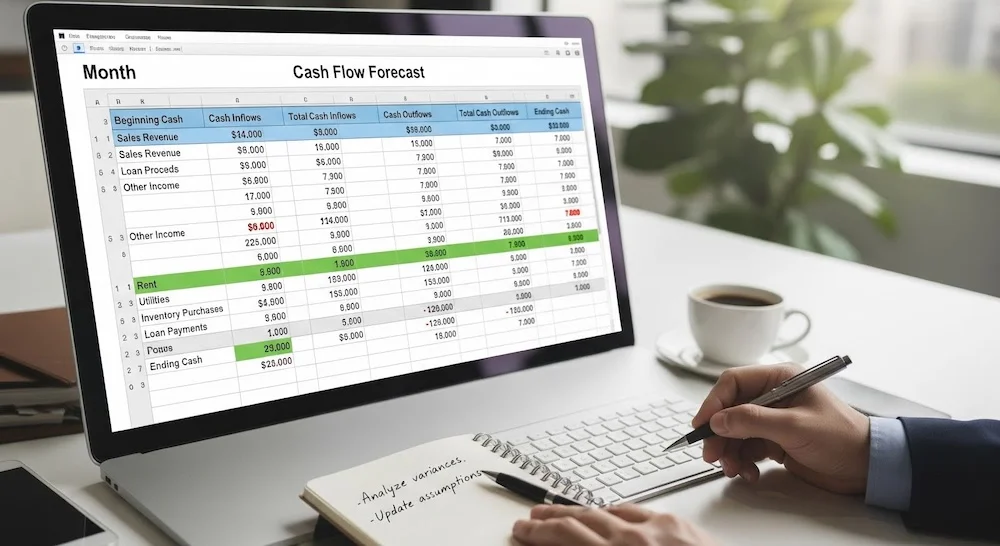
To better understand how a cash flow forecast works in practice, let’s look at a simplified example. This scenario involves a retail business projecting its finances for the upcoming month, using estimated inflows and outflows to assess liquidity.
Example Scenario:
A retail company begins in October 2025 with an opening cash balance of MYR 50,000. It expects MYR 120,000 in product sales, MYR 30,000 in pending receivables from previous clients, and an MYR 20,000 loan disbursement — bringing total projected inflows to MYR 170,000.
On the outflow side, the company anticipates spending MYR 60,000 on inventory purchases, MYR 35,000 on payroll, MYR 10,000 on rent and utilities, MYR 15,000 on marketing, and MYR 5,000 on loan repayments — totalling MYR 125,000 in outflows.
This results in a net positive cash flow of MYR 45,000, leading to a closing balance of MYR 95,000 by month’s end. With this insight, the business can plan short-term investments or ensure buffers for unplanned expenses, especially in times of market volatility.
Cash Flow Forecast Benefits- Why Is It Important?
A cash flow forecast is more than just a financial spreadsheet—it’s a decision-making compass for every department. Here’s how it helps:
- Liquidity Planning: A forecast helps ensure you don’t run out of cash when you need it most. By anticipating inflows and outflows, you can plan ahead for shortfalls, make better use of surplus funds, or arrange financing in advance.
- Better Decision-Making: Whether it’s timing a new hire or purchasing equipment, knowing your future cash position gives you confidence to make smarter, data-backed choices.
- Crisis Management: In periods of uncertainty like market disruptions, supply chain issues, or declining revenue, a good forecast gives you early warning signals so you can respond quickly with contingency plans.
- Stakeholder Confidence: Lenders, investors, and even internal management want to see that the company understands and controls its cash. A clear forecast helps build trust and credibility.
- Compliance and ESG Alignment: Financial forecasts are essential in sustainability and compliance reporting. When linked with ESG reporting frameworks, they help demonstrate responsible financial stewardship and resource planning.
Types of Cash Flow Forecasts
Different businesses have different planning needs, and choosing the right forecasting horizon is key to effective financial control. Here are the three most common types:
- Short-Term Forecasting (1 week to 3 months): This is best for day-to-day cash management—covering operational expenses like payroll, utility bills, and supplier payments. It helps ensure liquidity to avoid overdrafts or missed obligations.
- Medium-Term Forecasting (3 to 12 months): Often aligned with quarterly budgets or seasonal planning. It enables better coordination between marketing, procurement, and production cycles—especially useful for industries with fluctuating demand.
- Long-Term Forecasting (1 year or more): This strategic approach helps with planning for major investments, fundraising, or expansion into new markets. It is critical for understanding your company’s runway and capital allocation over time.
Key Components of a Cash Flow Forecast
A cash flow forecast is built around a few essential components that give you visibility into your business’s liquidity. Here’s what it typically includes:
Opening Cash Balance
This is the amount of cash your business has at the start of the forecast period. It sets the foundation for calculating all other cash movements and helps assess whether upcoming inflows and outflows will leave you with a positive or negative balance.
Cash Inflows
Includes all the money expected to enter the business during the forecast period. This may consist of customer payments, loan disbursements, investor funding, and interest income. Predicting these accurately is crucial to ensuring operational smoothness.
Cash Outflows
Refers to all expected expenses such as rent, payroll, utilities, supplier payments, capital expenditures, and debt repayments. A comprehensive understanding of these helps in avoiding cash shortfalls or late payments.
Net Cash Flow
This is calculated by subtracting total cash outflows from total inflows. A positive net cash flow indicates surplus liquidity, while a negative one signals a potential cash crunch.
Closing Balance
The closing cash position at the end of the forecast period. It helps gauge the financial health of the company and informs decision-making for the next cycle.
How To Do Cash Flow Forecast- Steps
Creating a reliable cash flow forecast requires a mix of financial discipline, realistic assumptions, and data accuracy. Below is a step-by-step breakdown of how to build one effectively:
Step 1. Identify the Forecasting Period and Objectives
Start by choosing the time horizon for your forecast. This could be weekly, monthly, or quarterly, depending on your business size and cash flow complexity.
- Short-term forecasts are ideal for operational cash planning (e.g., payroll, supplier payments).
- Long-term forecasts help in strategic planning, such as expansion or capital investment.
Clearly define what you’re trying to achieve, whether it’s preventing a cash crunch, planning for new hires, or meeting investor requirements.
Step 2. Collect Historical Financial Data
Gather at least 6–12 months of past cash flow data. This includes bank statements, sales reports, recurring expenses, and seasonal trends.
- Analysing past trends helps you establish realistic benchmarks for future inflows and outflows.
- Use accounting software or ERP tools if available, as they often provide built-in cash flow reports.
Step 3. Categorise Income and Expenses
Break down all incoming and outgoing cash into categories to improve visibility and forecasting accuracy.
- Cash Inflows: Include sales revenue, service income, investment income, loan proceeds, grants, and tax refunds.
- Cash Outflows: Include rent, salaries, vendor payments, loan repayments, insurance, CAPEX, and one-time expenses.
This step allows you to separate recurring cash activities from occasional ones, which is critical for reliable forecasting.
Step 4. Build the Forecast Using a Template or Tool
Create a spreadsheet or use a forecasting tool where you input the opening balance, expected inflows, outflows, and calculate the net cash flow for each period.
- A rolling forecast approach, where the model is continuously updated with actuals, helps you stay accurate.
- Consider creating multiple columns: one for projected, one for actual, and one for variance analysis.
Step 5. Integrate Real-Time Data Sources
Static spreadsheets are often outdated. Connect your forecast with real-time sources like your accounting software, sales platforms, or banking APIs.
- This provides live updates and prevents errors caused by data lags.
- Business Intelligence dashboards and integrations can streamline this step by pulling live data from various departments.
Step 6. Run Multiple Scenarios
Test different scenarios, such as optimistic, pessimistic, and base-case, so you’re not caught off guard.
- Factor in delays in receivables, unexpected expenses, or drops in revenue.
- This kind of “what-if” modelling prepares you to pivot when the market shifts.
Step 7. Review and Refine Regularly
Set a schedule to review your cash flow forecast weekly or monthly.
- Compare projections with actuals to understand where assumptions may have gone wrong.
- Adjust future periods based on real-world changes in operations, market demand, or supplier terms.
Common Challenges in Cash Flow Forecasting
Even with the best tools and intentions, cash flow forecasting can encounter a few stumbling blocks. Understanding these challenges helps you build more accurate and resilient forecasts.
- Unpredictable Payment Behaviour: Delayed customer payments or early supplier demands can throw off forecast accuracy and strain working capital.
- Inaccurate or Outdated Data: Relying on incomplete or old financial data leads to flawed assumptions and unrealistic projections.
- Static Spreadsheet Models: Manual Excel models often lack real-time data syncing, making it hard to adapt to dynamic changes in business conditions.
- Overlooked One-Offs and Seasonality: Irregular expenses (e.g., bonuses, tax payments) or seasonal fluctuations are often missed, leading to sudden cash gaps.
- Disconnected Teams and Systems: Lack of integration between sales, procurement, and finance can result in blind spots and missed updates.
Industries That Benefit from Accurate CashForecasting
Cash flow forecasting isn’t just for large corporations — it’s a critical planning tool across multiple sectors. Here’s how different industries apply it to maintain financial control and strategic flexibility:
- Manufacturing: Helps plan raw material purchases, optimise production cycles, and avoid cash crunches caused by delayed receivables or unexpected machine downtime.
- Retail & E-commerce: Manages seasonal sales fluctuations, promotional spend, and supplier payments while ensuring sufficient working capital during peak or lean periods.
- Real Estate & Construction: Forecasts cash needed for project milestones, vendor payments, and financing schedules, especially for large developments with staggered revenue inflows.
- Healthcare: Ensures smooth financial operations despite delayed reimbursements from insurance providers and manages expenses related to compliance and staffing.
- Small & Medium Enterprises (SMEs): Supports daily cash tracking, loan management, and debt servicing, while also improving creditworthiness with consistent cash visibility.
How Mandrill Supports Smarter Cash Flow Forecasting
Accurate cash flow forecasting requires more than just manual spreadsheets — it needs real-time data intelligence, predictive analytics, and seamless integration across systems.
This is where Mandrill enhances the entire forecasting process:
AI-Powered Predictions
Mandrill uses machine learning models to analyse past transaction patterns, seasonal trends, and macroeconomic signals to predict future cash inflows and outflows. These AI Intelligent Solutions help businesses proactively prepare for dips in liquidity or identify surplus cash opportunities to invest.
Real-Time Business Intelligence Dashboards
With Mandrill’s BI solution and dashboards, finance teams and executives gain a consolidated, real-time view of company-wide cash positions. You can track multiple KPIs from one visual interface.
Scenario Planning Tools
Mandrill allows you to simulate multiple forecasting models and assess how decisions (like price changes or hiring) impact future cash positions. These dynamic simulations help de-risk financial strategies.
ESG & Compliance Integration
Through Mandrill’s ESG Solutions and Lestar ESG Dashboard, financial forecasts can be mapped against sustainability performance metrics. For example, forecasting the budget required to meet energy-efficiency targets, or tracking green capex and compliance costs across reporting cycles.
Seamless Ecosystem Integration
Mandrill connects with your accounting tools, CRM, and other enterprise systems via API to ensure your forecasts are always based on live data. This integration eliminates manual data entry errors and allows faster reaction times to changing business conditions.
Conclusion
Effective cash flow forecasting is a critical pillar of business strategy and resilience. With accurate projections, companies can avoid liquidity crises, make confident growth decisions, and respond swiftly to changing market conditions.By adopting intelligent tools like Mandrill, businesses gain real-time visibility, predictive insights, and ESG-aligned planning capabilities that go far beyond traditional spreadsheets.
Ready to transform your financial reporting? Talk to the Lestar CEO360 team today.
More ESG Insights
Kimi K3's "Sputnik Moment": The License Terms Matter More Than the Benchmark Score
Moonshot AI's Kimi K3 triggered a stock selloff and a fresh "Sputnik moment" framing when it landed near frontier-model benchmark scores at a fraction of the cost. The more useful story for engineering teams is less visible: a Llama-style custom license with revenue and attribution thresholds, and a vendor disclosure that serving throughput was cut by more than half shortly after launch. Here's what to check before it goes into a build recommendation.
The Retrieval Architecture Debate: When Grep Beats a Vector Database, and When It Doesn't
Anthropic dropped vector search from Claude Code in favor of grep. Qdrant's enterprise customers are doubling down on vector search for their own agent workloads. Both are right — they're solving different retrieval problems. Here's a practical framework for figuring out which one fits yours.
Enterprise AI ROI in 2026: Why Efficiency Gains Aren't Becoming Revenue Growth
AI adoption is near-universal in 2026, but the financial payoff isn't following at the same pace. New survey data from McKinsey, Bain, and Deloitte shows why cost savings are landing reliably while revenue growth mostly isn't — and what separates the small group of companies getting both.
Ready to Centralise Your Enterprise Data?
Whether you need Lestar ESG for sustainability reporting, Lestar CEO360 for executive intelligence, or a fully customised enterprise data implementation — Mandrill Tech will tailor the solution to your organisation's needs.