The AI Data Readiness Gap: Why Confidence Keeps Outrunning Capability
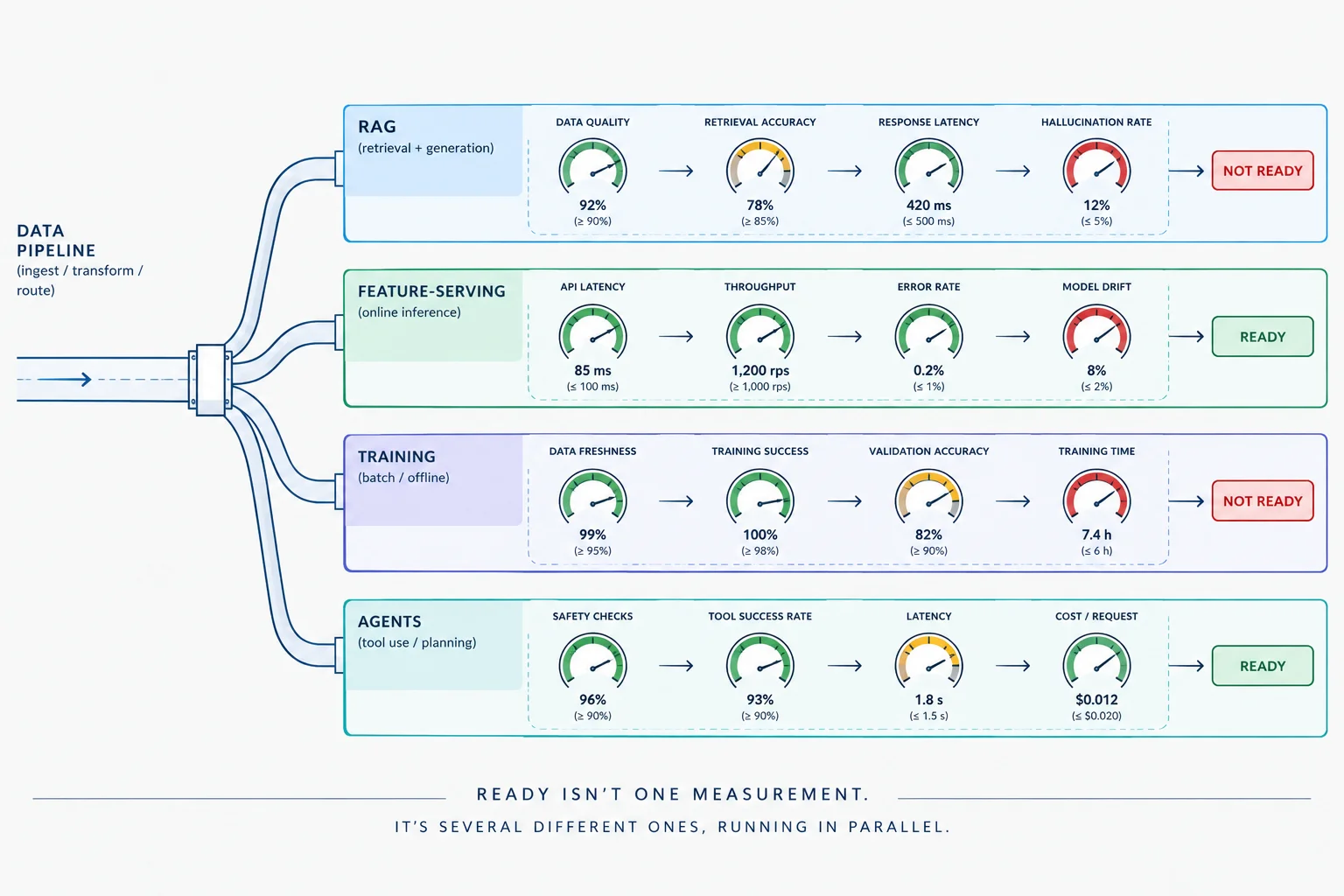
Nearly every enterprise now has an active AI initiative. Almost none of them can say, with evidence rather than confidence, that their data is actually ready to support it. That gap — not model quality, not compute — is what a run of large 2026 surveys keeps landing on as the reason so many AI programmes stall between pilot and production.
Here is what the data actually shows, and what the "AI-ready" framing gets wrong.
What Is Happening?
Five independently sponsored 2026 surveys converged on the same shape of finding. Cloudera's Data Readiness Index (1,270 IT leaders, April 2026) found 96% of organisations have integrated AI into core processes, yet ~80% say those initiatives are constrained by limited data access, and only 18% call their data "fully governed." Dun & Bradstreet's AI Momentum Survey (10,000 businesses, May 2026) found 97% running active AI initiatives against just 5% who say their data is fully ready. A Cloudera/Harvard Business Review Analytic Services survey put the same figure at 7%. Precisely and Drexel University's LeBow College of Business (505 data leaders, January 2026) found something sharper: 88% of leaders believe their data is AI-ready, while 43% simultaneously name data readiness as their single biggest obstacle — same people, same survey, contradicting themselves.
Deloitte's agentic AI readiness survey (501 senior leaders, August 2026) sharpens this further by moving from generic AI to autonomous agents: 72% lack unified, accessible data, and only 5% say their business processes are prepared for agents to operate in them.
Meanwhile, vendors selling into this problem have started responding at the engineering level. Snowflake published an open-source framework — six factors, 62 measurable, SQL-testable requirements — to operationalise what "AI-ready" actually means, introduced in a piece by a Snowflake engineer who spent most of it criticising his own industry's existing definitions.
Why It Matters
Every company behind these numbers — Cloudera, Precisely, Dun & Bradstreet — sells data or AI infrastructure, so none is a neutral observer. Worth stating upfront. What's harder to dismiss as vendor narrative: five differently sponsored, differently sampled surveys, run by competitors with no reason to hand each other a shared talking point, all land within a few points of "5 to 7% fully ready." A single vendor's number is marketing. The same number from five of them is a real signal.
What makes this an engineering problem rather than a procurement one is the shift to agentic AI. A dashboard built on stale or loosely governed data produces a wrong number a human can catch. An agent assembling context at query time and acting on it unattended turns the same data gap into a wrong action. TechTarget cites an Anthropic-attributed finding of agents scoring ~20–25% accuracy on analytical tasks without governed context, rising to 95% with it. The methodology isn't disclosed, so treat it as illustrative — but directionally it fits the pattern: "our data is basically fine" stops being safe once agents decide, not just display.
Understanding the Technology
"AI-ready data" isn't one thing — the industry has treated it as a single checkbox when it's really workload-specific. Three framings stand out:
Snowflake's six-factor model: Clean, Contextual, Consumable, Current, Correlated, Compliant — each broken into testable requirements that vary by workload (RAG: 27 checks, feature-serving: 39, training: 50, agents: 37).
Databricks' maturity model: raw → partially cleaned → fully validated, implemented via medallion architecture (Bronze/Silver/Gold), automated validation suites, and centralised feature stores that keep training-time and inference-time features consistent.
McKinsey's governance framing: unstructured data treated as a governed product, not a pipeline byproduct — with policy enforcement moved to runtime (what an agent may retrieve and generate), not just storage time.
The through-line: what's "ready" for a quarterly dashboard isn't what's ready for an agent retrieving, reasoning over, and acting on that data unattended.
What the Industry Is Learning
Demonstrated: Governance measurably changes outcomes. Organisations with established governance programmes report meaningfully higher trust in their own data (71% vs. 50% without, per Precisely/LeBow) — a within-survey comparison, not an aggregate claim. Structure-preserving parsing, controlled chunk sizes (Databricks engineers suggest 200–500 tokens, ~10% overlap), and domain-matched embeddings are reported by practitioners as directly affecting RAG retrieval quality.
Emerging, not conclusive: Snowflake's framework is a genuine attempt at a testable standard, but by GitHub's own signals (~80 stars, a handful of contributors) it's early-stage and Snowflake-specific.
Open debate: Cloudera, Dun & Bradstreet, and Precisely frame the problem in classic data-quality/access terms. McKinsey and TechTarget argue the deeper issue is organisational — data funded in project-scoped silos, producing "agent sprawl," echoing earlier "report sprawl." Both are evidence-backed; they aren't the same fix, and conflating them is a common misdiagnosis.
Our Engineering Perspective
The confidence-reality gap in the Precisely/LeBow data — 88% saying "ready," 43% naming the same area as their top obstacle — is the most useful finding here: most organisations are still assessing "AI-ready" by asking people, not by testing the data. That's the gap a testable framework like Snowflake's is trying to close, and it's the right instinct even though the tooling is early.
The distinction worth drawing is between readiness theatre and readiness engineering. Theatre is a self-reported confidence score or a vendor claim with no reproducible check behind it. Engineering is a specific, workload-scoped test — can this RAG pipeline retrieve the right chunk for a known query, does this feature store return the same value at training and inference time, is this table's lineage traceable — that a team can run before an agentic system goes live, not just before a dashboard ships.
For a Malaysian enterprise context, this matters because many of the data estates in scope — core banking paired with newer digital channels, plant-floor data still in spreadsheets, multi-outlet retail data across disconnected POS systems — were built for BI-era reporting, not for an agent assembling context at query time. The gap isn't unique to any region, but closing it starts the same way everywhere: a governed, centralised data layer that both BI and AI workloads can draw from.
We flagged vendor incentive above for the survey numbers; it applies just as much to proposed fixes, including the ones named here. The consistency of "5–7% ready" across differently sponsored surveys is the strongest evidence the gap is real — that doesn't extend the same credibility to any single vendor's claim that its own product is the fix.
Practical Considerations
Architecture: A medallion-style layered approach (raw → cleaned → validated) lets teams enforce workload-specific checks progressively rather than one universal bar.
Governance: Runtime enforcement (what an agent may retrieve and generate) is a different control point than storage-time governance. Only 18% call their data fully governed (Cloudera, April 2026), and a separate survey found just 23% have an established AI-specific data strategy at all (Cloudera/HBR, March 2026).
Observability: Distribution shifts that pass manual inspection are exactly what quietly degrades agent output. Monitoring needs to extend past ingestion into what the agent retrieves and assembles at query time.
Cost and scope: None of these frameworks are a one-time fix. Feature stores, lineage tracking, and chunk/embedding hygiene are ongoing investments, not a project with an end date.
Skills: Only 38% of organisations feel adequately staffed for AI work (Precisely). Tooling without people to run it doesn't close the gap.
Should Engineers Adopt It?
Experiment. The problem is well evidenced and consistent across independent sources. But the tooling response is early: Snowflake's framework is more concrete than what came before, yet still single-vendor and SQL-specific. No source here documents a mature, vendor-neutral standard or a disclosed, at-scale production case study.
Pilot workload-specific readiness checks — automated validation suites, lineage tracking on agent-facing pipelines, chunk/embedding review for RAG already in flight — rather than betting on one vendor's framework becoming the standard. What would change this: real cross-platform adoption of a vendor-neutral standard, or a disclosed case study of these checks catching failures before they reached an agent's output.
Conclusion
The surveys keep finding the same number from different directions because it's real: roughly 5 to 7% of enterprises have data that would pass an actual test, not a self-assessment. The organisations closing that gap aren't the ones with the most data or the most confident survey answers — they're the ones who stopped asking "is our data ready?" as yes-or-no, and started asking "ready for which workload, checked how."
Working with Lestar
If your organisation is investing in AI faster than in the data foundation underneath it, that gap is where Lestar was built to help — a centralised enterprise data platform built on the same principle this research points to: becoming AI-ready is a governance and consolidation problem before it's a model problem. Talk to Lestar.
More ESG Insights
Enterprise AI ROI in 2026: Why Efficiency Gains Aren't Becoming Revenue Growth
AI adoption is near-universal in 2026, but the financial payoff isn't following at the same pace. New survey data from McKinsey, Bain, and Deloitte shows why cost savings are landing reliably while revenue growth mostly isn't — and what separates the small group of companies getting both.
Agentic AI's Production Gap: Why Adoption Numbers and Deployment Numbers Tell Different Stories
Three-quarters of enterprise leaders say they've adopted agentic AI; independent research puts verified production ROI closer to five percent. This piece unpacks why those numbers aren't actually in conflict, and what separates the deployments compounding at scale from the ones Gartner expects will be canceled by 2027.
Malaysia's AI Governance Bill: Why the Compliance Work Starts Before the Law Does
Malaysia's AI Governance Bill hasn't passed Parliament, and its penalty schedule hasn't even been written — but the shape of its obligations already has. This piece breaks down the Developer/Deployer split, the overlap with existing PDPA law, and why engineering teams building or deploying AI in Malaysia have reason to start preparing before the law is finalized.
Ready to Centralise Your Enterprise Data?
Whether you need Lestar ESG for sustainability reporting, Lestar CEO360 for executive intelligence, or a fully customised enterprise data implementation — Mandrill Tech will tailor the solution to your organisation's needs.